© Magnific
June 24, 2026
Marianne Waldenfels
Tai Chi Walking Is Being Called the Health Trend of 2026. Here's What the Science Actually Shows, Who It's Right For, and Where the Hype Gets Ahead of Itself
Tai Chi Walking is probably one of the biggest health trends of 2026. Fueled by social media and health blogs, millions of people are discovering slow-paced walking for themselves. But how much science actually lies behind the hype? The answer is more nuanced than the trend might suggest.
Tai Chi Walking is a mindful walking technique that combines elements of the traditional Chinese movement art Tai Chi with slow, deliberately executed walking. Unlike casual walking or power walking, the focus is not on speed or distance, but on the controlled shifting of weight from one leg to the other, synchronized with the breath.
Practice often takes place on the spot as well. The goal is less about cardiovascular training effects and more about activating the parasympathetic nervous system — the body's natural recovery response.
It's as if someone hit the pause button while the world around you keeps fast-forwarding: within a year, search demand for the term has multiplied, leaving all other fitness trends of 2026 far behind.
Here's the context: Tai Chi Walking resonates in an era where the 10,000-step benchmark is no longer the ultimate measure, and the real question is how movement can counteract digital overstimulation and chronic stress.
Tai Chi Walking is not an independently researched training concept, but rather a simplified, everyday-friendly derivative of traditional Tai Chi Chuan (Taijiquan), which has been the subject of clinical research for decades. This means that the scientific evidence cited by the current trend comes predominantly from studies on classical Tai Chi training — not from research into the brief, virally spread walking format itself.
For any serious evaluation, this distinction is crucial: the benefits are real, but they depend on regular, structured practice — not on every variation circulating under the trend's name.
Unlike many short-lived fitness trends, Tai Chi is backed by a comparatively solid body of research spanning several decades and hundreds of studies. Three areas of benefit are particularly well documented:
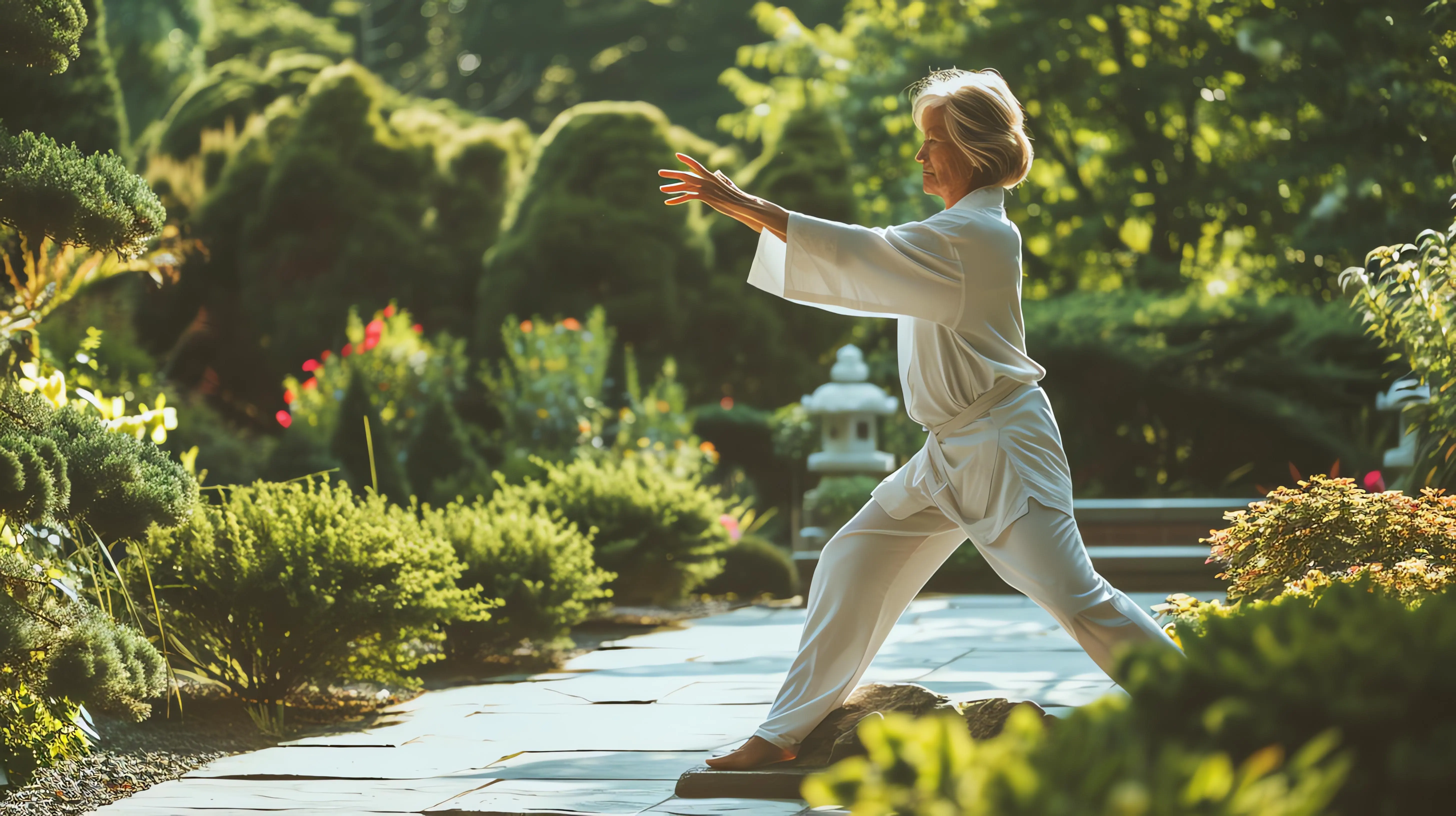
The strongest evidence relates to fall prevention. A randomized controlled trial published in JAMA Internal Medicine in 2018, involving 670 adults aged 70 and older, found that a therapeutic Tai Chi program was more effective at preventing recurrent falls than multimodal exercise training or conventional stretching.
A meta-analysis published in the Journal of the American Geriatrics Society, which evaluated ten randomized studies, concluded that Tai Chi could reduce the short-term fall rate by around 43 percent — and falls resulting in injury by approximately 50 percent — compared to other treatment approaches such as physiotherapy or gymnastics.
A Taiwanese RCT study of 456 fall-prone adults over 60 found a 70 percent reduction in fall frequency after six months of training compared to a conventional leg-training group. After twelve months, the effect remained at 68 percent — a lasting result that is very much the exception in the fast-moving world of fitness.
A study published in the New England Journal of Medicine in 2012 also found that Tai Chi can improve balance in Parkinson's patients and reduce falls — in fact, it outperformed traditional strength training in this study.
This effect is attributed in part to shorter neuromuscular reaction times, which became measurable after extended training — a factor that helps determine whether the body can still compensate for a stumble or not.
Tai Chi is also considered a moderate endurance and strength training activity. Its energy expenditure is estimated to be roughly equivalent to that of brisk walking at around 6 km/h. The slow, controlled movements combined with mindful breathing are associated with activation of the parasympathetic nervous system — the branch of the autonomic nervous system responsible for rest and recovery. This sets Tai Chi apart from more intensive forms of training, such as HIIT, which tend to raise cortisol levels in the short term.
It is worth noting, however, that scientists point out that Tai Chi, as a complex movement practice, can produce effects that are not always fully captured by classical quantitative measurement methods. A lack of demonstrable effect in a single study does not automatically mean that no effect exists — and equally, a single positive finding does not constitute established evidence, but rather indicates only a tendency.
• Conscious weight shifting: One foot is placed down gently, initially without bearing weight — usually starting with the heel — before the weight slowly and fully transfers onto it.
• Distinction between the "full" and "empty" leg: At any given moment, one leg bears the body's weight while the other moves freely — this distinction keeps attention anchored to the movement itself.
• Synchronized breathing: Inhalation and exhalation are consciously coordinated with each step, as in other meditative movement practices.
• No pace goal: The focus is not on distance or speed; practice often takes place in one spot or over very short distances.
To get started, 10 to 15 minutes a day is enough, ideally in a quiet place free from distractions. Those who want to make sure they are doing it correctly will benefit from guidance by a Tai Chi instructor — the balance elements in particular are difficult to learn properly from videos alone.
• Older people at risk of falling: This is where the evidence is strongest — though it applies to structured Tai Chi training over several weeks, not occasional short sessions.
• People with chronic stress or mild anxiety symptoms: The calming effect on the nervous system is plausible and backed by research on Tai Chi more broadly.
• People with mobility limitations: The slow, joint-friendly movements make this technique accessible even to those who cannot participate in more intensive forms of exercise.
Tai Chi Walking is less suitable as a standalone approach for those whose primary goals are cardiovascular fitness or building muscle. For these goals, professional organizations continue to recommend supplementing with moderate endurance training and targeted strength training.
Tai Chi Walking benefits from a trendy name that promises more than the format itself has been scientifically studied to date. The underlying practice — classical Tai Chi — on the other hand, has one of the stronger evidence bases among mindfulness-based movement forms, particularly for fall prevention and balance training in older adults.
Tai Chi Walking is no miracle cure. As a simple introduction to regular, mindful movement, however, the method can be well worth trying. Those who want to experience the scientifically proven benefits should, in the long run, practice classical Tai Chi.
The specific social media format has not yet been independently studied. What is well documented, however, is the effect of classical Tai Chi, from which the technique is derived — including its benefits for fall prevention, balance, and stress regulation.
Studies on traditional Tai Chi have typically involved one to four training sessions per week over a period of several weeks to months. For everyday beginners, 10 to 15 minutes of daily practice is considered a sensible starting point.
No. The energy expenditure is roughly equivalent to that of brisk walking. For cardiovascular health and muscle maintenance, additional endurance and strength training is still recommended.